How the RapidX ViscoPen can help fight South Africa’s illicit fuel problem
South Africa’s illicit fuel trade creates serious risks for businesses that depend on diesel-powered vehicles, equipment, and machinery. Adulterated diesel can move through parts of the supply chain unnoticed, exposing fleet operators, mines, farms, workshops, and industrial users to engine damage, downtime, and rising maintenance costs.
The RapidX ViscoPen gives businesses a practical way to respond. By allowing users to perform rapid on-site diesel testing, the device helps identify suspicious fuel before it enters critical equipment. In a market where illegal fuel blending remains a growing concern, that speed can make a measurable difference.
South Africa’s illicit fuel problem continues to threaten diesel users
Recent reporting has highlighted the scale of the illicit fuel problem in South Africa. Authorities and industry stakeholders have raised concerns about the mixing of diesel with paraffin, the operation of suspected illegal fuel depots, and the sale of adulterated diesel through parts of the fuel market.
For diesel users, this creates a direct operational threat. When businesses buy contaminated fuel, they do not only face a compliance problem. They face the possibility of reduced engine performance, increased wear, costly repairs, and lost productivity.
That is why illicit fuel in South Africa has become more than a regulatory issue. It has become a reliability, maintenance, and asset-protection issue.
Why adulterated diesel is dangerous
Adulterated diesel changes the physical properties of the fuel. When suppliers mix diesel with paraffin or other substances, the fuel may no longer perform as expected inside an engine or fuel system. This can affect combustion, reduce lubrication quality, and accelerate wear on critical engine components.
For businesses that run diesel-powered assets every day, the consequences can be severe. Contaminated fuel can increase strain on injectors, pistons, cylinders, and other fuel-sensitive parts. It can also trigger unplanned downtime and disrupt operations where uptime matters most.
This is why diesel quality testing in South Africa is becoming increasingly important. Businesses need a faster way to identify suspicious diesel before it causes damage.
How the RapidX ViscoPen works
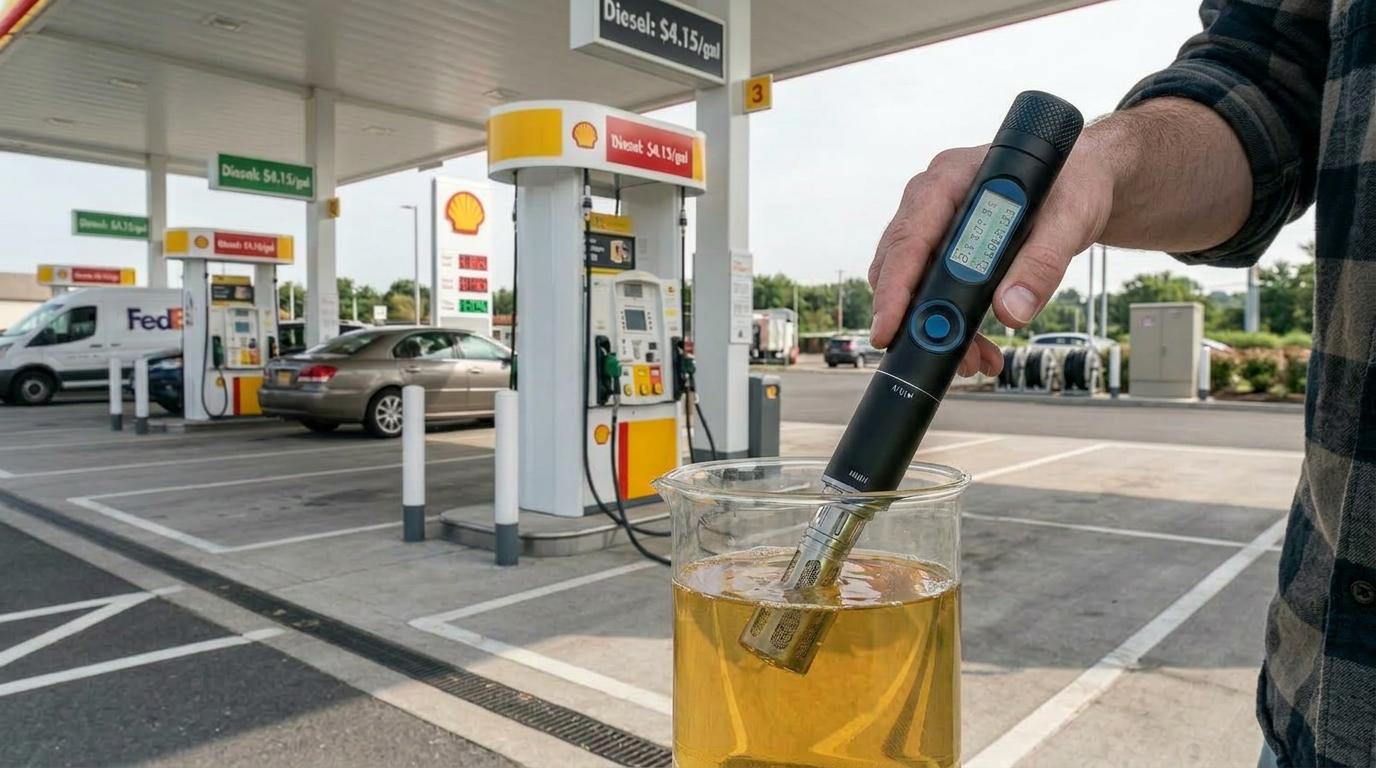
The RapidX ViscoPen is a handheld fluid analyser designed for rapid on-site testing of diesel fuel, lubricants, and industrial fluids. According to Yateks Africa, the device uses piezoelectric resonant MEMS technology to measure viscosity, density, and temperature within seconds.
Its compact pen-style design supports field use, while its one-button operation makes testing simple and practical. Yateks Africa also states that the device includes an IP67-rated probe, allowing operators to carry out quick and reliable fluid condition checks in demanding environments.
This makes the RapidX ViscoPen particularly useful for businesses that need portable diesel fuel testing without waiting for full laboratory analysis before making an immediate decision.
How the RapidX ViscoPen helps detect illicit fuel
The strongest value of the RapidX ViscoPen for illicit fuel detection lies in its ability to identify abnormal fuel characteristics quickly. Yateks Africa states that the device can support the immediate identification of paraffin adulteration, which is especially relevant in the South African market.
When illicit fuel enters the supply chain, users often struggle to identify it through appearance alone. A visual inspection may not reveal whether someone has mixed diesel with paraffin or another contaminant. The RapidX ViscoPen helps solve that problem by measuring fuel properties that matter.
Because the device measures density, viscosity, and temperature, it gives operators fast on-site data that can help them screen suspicious diesel. If the fuel behaves outside expected parameters, the user can isolate the batch, avoid using it in equipment, and escalate the issue for further investigation.
That makes the RapidX ViscoPen an effective first-line fuel contamination detection tool.
Why viscosity, density, and temperature matter
When businesses test fuel quality, they need more than guesswork. They need measurable data. The RapidX ViscoPen provides that by analysing three key indicators:
Density
Density can help reveal whether the fuel’s composition has changed. If diesel has been adulterated, its density may fall outside expected values.
Viscosity
Viscosity affects how fuel flows and performs. Changes in viscosity can indicate contamination, quality issues, or product inconsistency.
Temperature
Temperature affects how fluids behave during testing. Measuring temperature alongside density and viscosity gives users a more useful and reliable picture of the fuel sample.
Together, these measurements help businesses perform on-site diesel quality testing more confidently and consistently.
Why rapid on-site diesel testing matters
Speed matters when fuel decisions happen at the point of delivery, storage, or refuelling. A fleet manager, fuel buyer, workshop supervisor, or maintenance team often cannot wait for a lengthy laboratory process before deciding whether to accept a diesel batch.
The RapidX diesel fuel tester helps bridge that gap. It allows users to screen fuel immediately and act before a suspicious batch reaches expensive machinery or vehicles. This proactive approach supports:
- faster decision-making
- better fuel quality control
- reduced risk of equipment damage
- lower exposure to contaminated fuel
- improved maintenance planning
For many businesses, rapid testing can become an important part of a broader fuel quality assurance strategy.
Which industries can benefit from the RapidX ViscoPen?
The RapidX ViscoPen South Africa solution can support any industry that relies on diesel fuel quality and equipment uptime. This includes:
- transport and logistics
- mining
- agriculture
- construction
- power generation
- workshops and service operations
- industrial processing plants
- fleet management businesses
Any operation that stores, buys, distributes, or uses diesel can benefit from quicker screening and earlier detection of suspicious fuel.
A practical tool against illicit fuel in South Africa
The RapidX ViscoPen does not replace full laboratory testing when legal proof or detailed forensic analysis is required. However, it gives businesses something highly valuable in everyday operations: a fast and practical way to screen diesel on site.
In a market where illicit fuel can cause serious operational and financial damage, the ability to identify suspicious diesel quickly gives businesses an important line of defence. The RapidX ViscoPen helps companies take control at the point where fuel decisions matter most.
For businesses looking to reduce the risks linked to adulterated diesel in South Africa, the RapidX ViscoPen offers a smarter, faster, and more proactive approach to fuel quality testing.