Detect change earlier
Trend changes continuously instead of waiting for the next scheduled sample interval.

Move beyond periodic oil sampling with continuous visibility of lubricant condition. Yateks oil quality sensors monitor critical parameters such as viscosity, density, dielectric constant, water activity, dissolved moisture and temperature—helping maintenance teams identify changes earlier and make better reliability decisions.
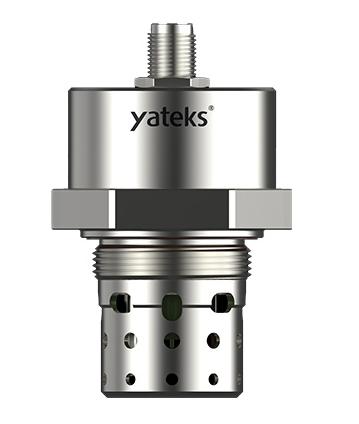
A laboratory sample remains important for detailed diagnosis, but it is a snapshot. Online oil quality sensors add a continuous trend between samples, helping engineers detect shifts in fluid condition, water contamination and operating behaviour earlier.
Trend changes continuously instead of waiting for the next scheduled sample interval.
Apply continuous monitoring to gearboxes, hydraulic systems, transformers and rotating machinery.
Use condition data to support inspection, filtration, dehydration, resampling and oil-change decisions.
Combine sensor trends with laboratory analysis, vibration data and maintenance history.
The correct sensor depends on the failure mode you are trying to detect. A gearbox may need viscosity and contamination trending, while a transformer or turbine may place much greater emphasis on dissolved moisture.
Start with the parameter you need to monitor, then select the smallest sensor set that covers the reliability objective. ISO-Reliability Partners can assist with application selection and integration.
The broadest multi-parameter option for continuous oil-condition trending.
For applications requiring viscosity, density and oil-quality trending without dedicated moisture measurement.
A focused physical-condition sensor for viscosity, density and temperature monitoring.
Designed to continuously trend dielectric constant and temperature as an indicator of oil-condition change.
For low-level dissolved moisture monitoring in transformer, lubricating and hydraulic oils.
Purpose-built for higher water-content applications where free or emulsified water is the concern.
Use this quick comparison to identify which sensor family best matches the required measurement.
| Measurement | YTS 6-in-1 | YTS 4-in-1 | YTS 3-in-1 | YTS-D-1 | YTS-M-1 | YTS-W-1 |
|---|---|---|---|---|---|---|
| Viscosity | ✓ | ✓ | ✓ | — | — | — |
| Density | ✓ | ✓ | ✓ | — | — | — |
| Temperature | ✓ | ✓ | ✓ | ✓ | ✓ | ✓ |
| Dielectric constant | ✓ | ✓ | — | ✓ | — | — |
| Water activity | ✓ | — | — | — | ✓ | — |
| Dissolved moisture (ppm) | ✓ | — | — | — | ✓ | — |
| Free / emulsified water | — | — | — | — | — | ✓ |
Online sensing is especially valuable on critical, continuously operated or difficult-to-sample equipment.
A sensor only adds value when the measurement is tied to a defined reliability action.
Identify the dominant failure mode: water, viscosity shift, degradation or general oil-condition change.
Choose the Yateks sensor that measures the smallest useful set of parameters for that application.
Trend against healthy oil, normal operating temperature and known machine condition.
Define alarm, inspection, resampling, filtration or maintenance actions when trends move outside limits.
An oil quality sensor continuously measures one or more physical or electrical properties of oil, allowing maintenance teams to trend lubricant condition while the machine is operating.
No. Online sensors are best used for continuous early warning and trend monitoring, while laboratory analysis provides broader diagnostic information such as wear metals, additive condition and detailed contamination testing.
Use the YTS-M-1 where dissolved moisture at ppm level is the main concern. Use the YTS-W-1 where higher free or emulsified water content must be monitored. The YTS 6-in-1 also includes water activity and dissolved moisture measurements.
The YTS 3-in-1, YTS 4-in-1 and YTS 6-in-1 sensors measure viscosity together with additional oil-condition parameters.
Typical installations include lubrication circuits, hydraulic systems, gearboxes, transformer oil systems and other circulating-fluid applications where representative, stable flow conditions can be achieved.
Alarm limits should consider the oil type, OEM requirement, fresh-oil baseline, normal temperature range, asset criticality and historical trend. A rate-of-change alarm can be as important as an absolute limit.
Send ISO-Reliability Partners the asset type, lubricant, normal operating temperature, target parameters and available installation point. We can help narrow the sensor choice and define the monitoring objective.