
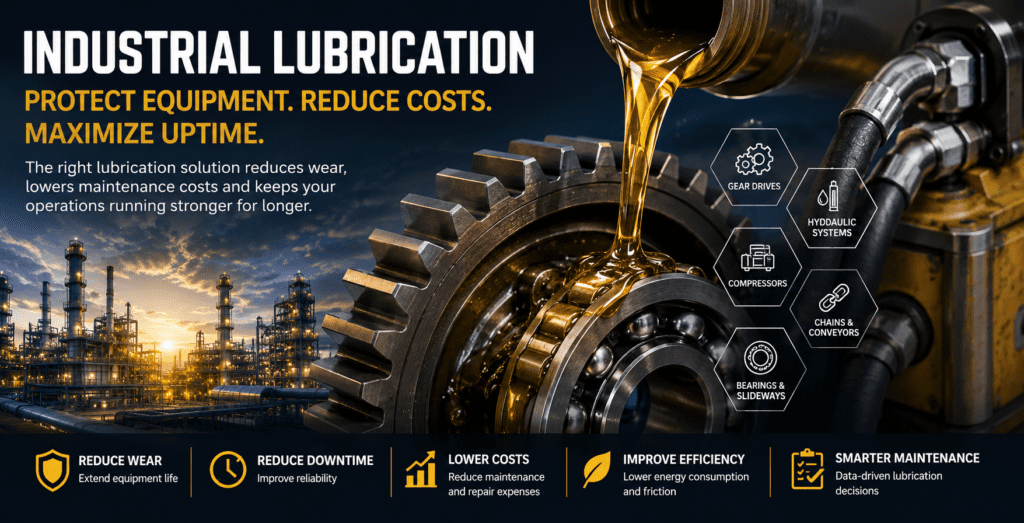
Industrial Lubrication Solutions That Reduce Wear, Downtime and Maintenance Costs
Industrial lubrication is not just about applying oil or grease. It is a cost-saving reliability strategy. The correct lubricant helps protect gears, bearings, chains, compressors, hydraulic systems and heavy-duty equipment from premature wear, heat, friction, corrosion and unplanned failure.
Why Industrial Lubrication Is a Direct Cost-Saving Opportunity
Every rotating component in your plant depends on the correct lubricant film. When that film fails, the result is usually increased friction, higher operating temperature, accelerated wear, energy loss and expensive downtime. A well-planned industrial lubrication programme helps your maintenance team move from reactive repairs to controlled, measurable equipment reliability.
Reduce Component Wear
Correct lubricant selection creates the protective film needed between moving surfaces. This helps reduce metal-to-metal contact, extends component life and protects high-value equipment.
Reduce Unplanned Downtime
Lubrication-related failures often lead to emergency repairs and production losses. Better lubricant control helps maintenance teams plan ahead instead of reacting after damage occurs.
Lower Total Cost of Ownership
The cheapest lubricant is not always the most cost-effective lubricant. The right industrial lubricant can help reduce maintenance frequency, energy loss, replacement parts and production interruptions.
The Real Cost of Poor Lubrication
Poor lubrication does not only cost money when a machine fails. It quietly increases operating cost every day through heat, friction, contamination, oil degradation and unnecessary component stress.
Visible Costs
- Replacement bearings, gears, chains and seals
- Emergency call-outs and overtime labour
- Production stoppages and delivery delays
- Higher lubricant consumption
Hidden Costs
- Increased energy consumption from friction
- Shortened equipment life
- Reduced production efficiency
- Contamination-related damage inside systems
Industrial Lubrication Applications We Support
A strong lubrication programme must match the lubricant to the application, load, speed, temperature, environment and maintenance interval. Industrial operations often require different lubricant technologies across the same site.
From Lubricant Supply to Reliability Improvement
Industrial lubrication should be managed as part of a complete reliability programme. That means choosing the right product, applying it correctly, monitoring oil condition and reducing contamination before it causes failure.
Lubricant Selection
Select industrial oils and greases according to equipment type, OEM requirements, operating temperature, load, speed and environmental exposure.
Lubricant Management
Improve storage, handling, transfer, filtration and application practices to reduce contamination and extend lubricant performance.
Condition Monitoring
Use oil analysis, viscosity checks and contamination control to identify problems before they become expensive failures.
Bel-Ray Industrial Lubrication
Bel-Ray industrial lubricants are designed for demanding applications where equipment protection, reliability and total cost of ownership matter. The product range supports applications such as gears, hydraulics, compressors, chains, conveyors, bearings, slideways, mining and food-grade environments.
- Suitable for tough industrial operating conditions
- Solutions for gear drives, open gears and hydraulic systems
- Options for food and beverage processing environments
- Focused on equipment protection and reliability
Royal Purple Industrial Lubrication
Royal Purple synthetic lubricant technology is positioned around performance, protection, efficiency and productivity. For operations looking to reduce friction-related losses and improve equipment reliability, synthetic lubrication can be a powerful cost-saving upgrade.
- Advanced synthetic lubricant technology
- Designed to support performance and protection
- Helps target maintenance savings and productivity gains
- Suitable for demanding commercial and industrial applications
How Better Industrial Lubrication Saves Money
The goal is not simply to buy a better lubricant. The goal is to reduce the total cost of running the equipment. When lubrication is treated as a reliability tool, it helps maintenance teams save money across the full life cycle of the asset.
Identify High-Cost Lubrication Points
Start with the machines that cause the most downtime, consume the most lubricant or experience recurring bearing, gear, hydraulic or chain failures.
Match the Lubricant to the Application
Select the correct viscosity, base oil, additive package, grease thickener and performance level for the equipment and operating conditions.
Control Contamination
Keep dirt, water and incorrect fluids out of the system. Contamination is one of the fastest ways to shorten lubricant and component life.
Monitor Oil Condition
Use oil analysis and field testing to track viscosity, contamination, wear metals and degradation. This supports planned maintenance decisions.
Measure the Savings
Track downtime, lubricant consumption, oil drain intervals, component life and maintenance labour to prove the financial benefit of the programme.
Industries That Benefit from Industrial Lubrication Programmes
Any operation that depends on rotating equipment, hydraulic power, gearboxes, conveyors or heavy-duty machinery can benefit from improved industrial lubrication.
Mining & Quarrying
Protect open gears, bearings, hydraulic systems, conveyors, crushers, mills and mobile equipment exposed to heavy loads, dust and harsh conditions.
Manufacturing
Improve reliability on gearboxes, compressors, chains, conveyors, bearings, slideways and production-critical rotating equipment.
Food & Beverage
Support production reliability with the correct food-grade lubrication approach for clean processing environments and sensitive applications.
Fleet & Transport
Reduce wear and protect high-value commercial vehicles, yellow metal, hydraulic systems and driveline components.
Agriculture
Improve uptime on tractors, harvesters, pumps, gearboxes, chains, bearings and hydraulic equipment working under dust, heat and load.
Energy & Utilities
Support compressors, pumps, gear drives, turbines, generators and other reliability-critical equipment with the correct lubrication strategy.
Industrial Lubrication Is a Maintenance Engineer’s Cost-Control Tool
Maintenance teams are under constant pressure to reduce breakdowns, control budgets and keep production moving. A properly engineered lubrication programme gives them a practical way to improve reliability without replacing major equipment.
By improving lubricant selection, contamination control, oil condition monitoring and application practices, industrial plants can protect assets, reduce recurring failures and make maintenance spending more predictable.
Industrial Lubrication FAQs
What is industrial lubrication?
Industrial lubrication is the use of oils, greases and specialty lubricants to reduce friction, wear, heat and corrosion in industrial equipment such as gears, bearings, compressors, hydraulics, chains and conveyors.
How does industrial lubrication reduce maintenance costs?
It helps reduce premature wear, overheating, energy loss, contamination-related damage and unplanned downtime. This can lower the cost of repairs, replacement parts, labour and production interruptions.
Is a premium lubricant worth the extra cost?
In many critical applications, yes. A premium lubricant can cost more per litre but may reduce total operating cost by improving protection, extending component life and reducing downtime.
What equipment needs industrial lubrication?
Common applications include enclosed gears, open gears, bearings, hydraulic systems, compressors, chains, conveyors, slideways, pumps, mining equipment, fleet equipment and food-processing machinery.
How often should industrial lubricants be tested?
Testing frequency depends on the equipment, criticality, environment and operating conditions. Critical assets should be monitored regularly using oil analysis, viscosity checks and contamination testing.
Can industrial lubrication help reduce downtime?
Yes. Correct lubricant selection, clean oil handling and condition monitoring can identify lubrication problems before they cause equipment failure.
Start Reducing Maintenance Costs with a Smarter Lubrication Strategy
Industrial lubrication is one of the most practical ways to protect equipment, improve uptime and reduce the total cost of ownership. Let us help you identify the right lubrication solution for your plant, fleet or heavy-duty operation.