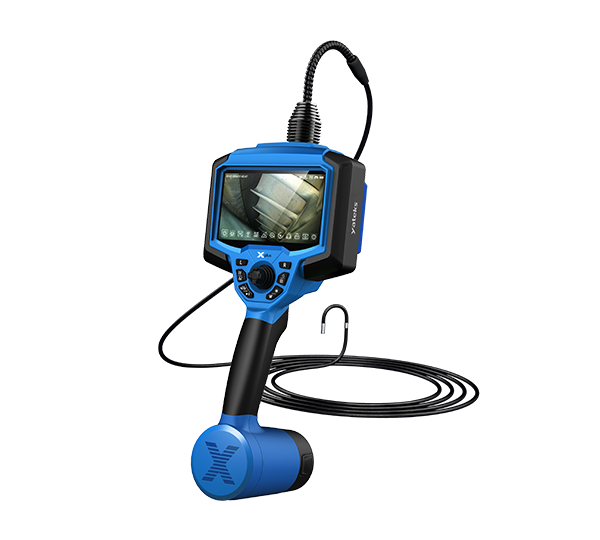
A remote visual inspection system, not just a camera
The XPlus is aimed at inspections where the report matters as much as the
look: turbine sections, wind assets, rail components and pressure systems.
It runs an Android-based operating system with three neural processing units,
8 GB of RAM and a 128 GB solid-state drive, so recordings, log files
and future software tools all live on the instrument itself.
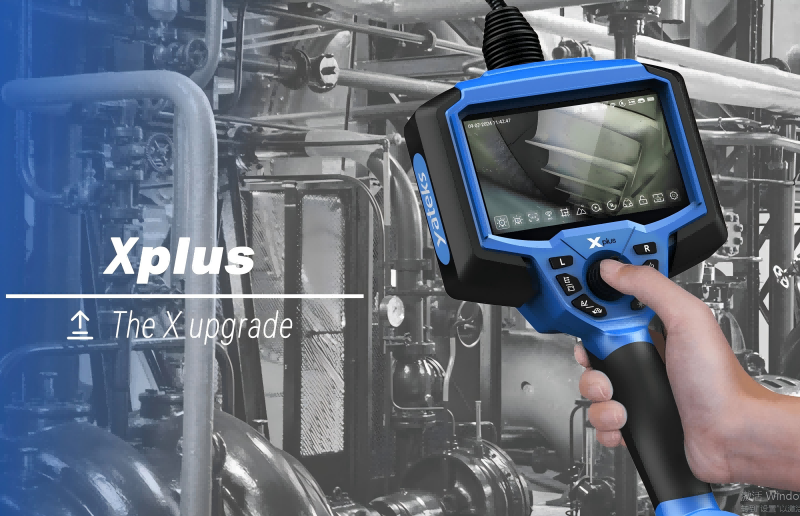
Joystick control with a locking brake
Probe steering is precise and lag-free, and the patented automatic brake
holds the tip where you put it. That matters on long inspections, because
the view stays put while you photograph it, annotate it or bring someone
over to look.
Steering Map tip positioning
An on-screen display shows where the camera head is pointing. Deep inside
a casing you lose all sense of orientation, so knowing the tip attitude is
the difference between a repeatable inspection and a guess about which
blade you were looking at.
A display you can match to the light
The high-resolution, high-contrast screen adjusts to ambient brightness.
As a result the same instrument works in a dark turbine hall and outdoors
on a wind tower, without the washed-out screen that makes defect calls
unreliable.
Camera heads for the job, not just the hole
Probes use CMOS sensors with multipixel technology, in a choice of depth
of field ranges and viewing directions, including multi-camera heads.
Illumination options cover white-light fibre, LED, infrared and UV, and
some heads carry built-in sensors such as temperature.
Ports for real site work
Two USB-A sockets, one USB-C, HDMI out for an external HD screen and an
audio socket for a microphone. You can narrate a video as you record it,
which is far quicker than writing the commentary up afterwards. A
real-time clock timestamps defined inspection periods.
Backed locally, not just shipped
ISO-Reliability Partners holds the Yateks range for the African market.
You get local quoting, probe selection advice and after-sales support from
the same team that handles our
oil analysis and
preventative maintenance
programmes.
Choosing probes and camera heads
The XPlus takes interchangeable probes, so one base unit covers a wide range
of access points and lighting conditions. Diameter, illumination and viewing
direction are specified separately, which is what lets the instrument suit
several very different inspections.
Diameter
2.3 – 8.4 mm
The range spans tight-access work through to large-bore inspection. The
probe outer skin is tungsten-braided for abrasion resistance in service.
Illumination
White · LED · IR · UV
White-light fibre and LED cover general inspection. Infrared and UV heads
open up fluorescent penetrant work, leak tracing and contamination checks
that white light alone will not show.
Optics and sensing
MPT CMOS
Multipixel-technology sensors are offered in several depth-of-field ranges
and viewing directions, including multi-camera heads. Some heads carry
built-in sensors such as temperature.
Published specification
System and hardware
Yateks XPlus system and hardware specifications
| Operating system | Android-based, icon-driven touchscreen interface |
|---|
| Memory | 8 GB RAM, upgradable |
|---|
| Storage | 128 GB built-in SSD |
|---|
| Processing | Three built-in neural processing units (NPUs) |
|---|
| Display | High-resolution, high-contrast, adjustable to ambient brightness |
|---|
| Ports | 2 × USB-A, 1 × USB-C, HDMI output, audio socket |
|---|
| Audio | Microphone input for dubbing video recordings |
|---|
| Timing | Real-time clock for measuring defined periods |
|---|
| Wireless | Built-in WLAN and Bluetooth |
|---|
Probe and camera head
Yateks XPlus probe and camera head specifications
| Articulation | Full 360°, four-way |
|---|
| Tip control | Joystick, with patented automatic locking brake |
|---|
| Tip orientation display | Steering Map probe head positioning |
|---|
| Probe diameters | 2.3 mm to 8.4 mm |
|---|
| Image sensor | CMOS with multipixel technology (MPT) |
|---|
| Head options | Multiple depth-of-field ranges, viewing directions, multi-camera heads |
|---|
| Illumination | White-light fibre, LED, infrared, UV |
|---|
| Built-in sensors | Temperature sensing available on selected heads |
|---|
| Insertion tube | Robust outer skin with tungsten braiding |
|---|
Working lengths, battery life, ingress protection and operating temperatures
vary by configuration. Ask us for the
full XPlus datasheet and we will send the figures for the probes you are
considering.
Planned and upgradeable functions
Because the XPlus runs a full operating system, Yateks lists a set of
functions as upgradeable rather than fixed at purchase. Availability differs
by configuration and firmware version, so treat the list below as a roadmap
and confirm what is active on your unit before you buy on the strength of it.
- Optical recognition of signs, barcodes and QR codes
- Detailed log files covering runtime and operating temperature
- Over-the-air remote service and software updates
- Built-in measurement functions with 3D point cloud
- Artificial intelligence functions running on the three onboard NPUs
We will confirm in writing which of these are enabled on the configuration we
quote you. If 3D defect measurement is a firm requirement today rather than
later, tell us and we will point you at the right instrument for it.
Where the XPlus earns its keep
This is the instrument for inspections that are scheduled, documented and
audited, rather than quick look-and-see checks. These are the sectors it is
built for.
- Wind energyBlade roots, gearboxes and tower internals, often at height and in daylight.
- Power generationTurbine and combustion section inspections during a planned outage.
- RailTraction components and structures on a fixed maintenance schedule.
- Aviation and aerospaceDocumented borescope inspections where the record has to hold up.
- Oil, gas and petrochemicalPipework, vessels and heat exchangers with long reach requirements.
- Heavy mining equipmentLarge gearboxes, engines and hydraulic systems on critical assets.
Visual inspection works best alongside fluid data. Pairing videoscope findings
with oil analysis and condition monitoring
tells you both what the wear looks like and what it is made of.
Frequently asked questions
How does the XPlus compare with the M-ADV and G Series?
The G
Series is a fixed-view borescope for routine daily checks. The
M-ADV
adds joystick articulation in a light handheld body. The XPlus sits above
both: four-way articulation, a far wider probe and illumination range, and a
computing platform that stores and processes the inspection record.
What does four-way articulation actually give me?
It means the tip bends on two axes rather than one, so you can reach any
point in a 360° sweep instead of only up and down. On a turbine blade or
a weld root, that is the difference between seeing the defect and seeing
past it.
What are the UV and infrared camera heads for?
UV heads support fluorescent penetrant inspection and leak tracing, where a
dye glows under ultraviolet light. Infrared heads pick up thermal detail
that white light cannot show. Both are specified per probe, so tell us the
inspection method and we will match the head to it.
Can it take measurements of a defect?
Yateks lists built-in measurement with a 3D point cloud among the
upgradeable functions rather than as a standard feature. If measurement is a
firm requirement now, ask us about the Realta 3D and P Series instruments,
which are built around it.
How do I get inspection footage off the unit?
Recordings sit on the 128 GB internal SSD. Copy them over USB-A or
USB-C, or use the built-in WLAN. HDMI drives an external HD screen if
someone else needs to watch the inspection live.
Do you support the equipment in South Africa?
Yes. ISO-Reliability Partners supplies the Yateks range across Africa from
Germiston, Gauteng, and handles quoting, training, spares and service
locally. Call +27 10 449 6414 or
send us a message.